
Language-Anguish
On Sanskrit and its Discontents

1.
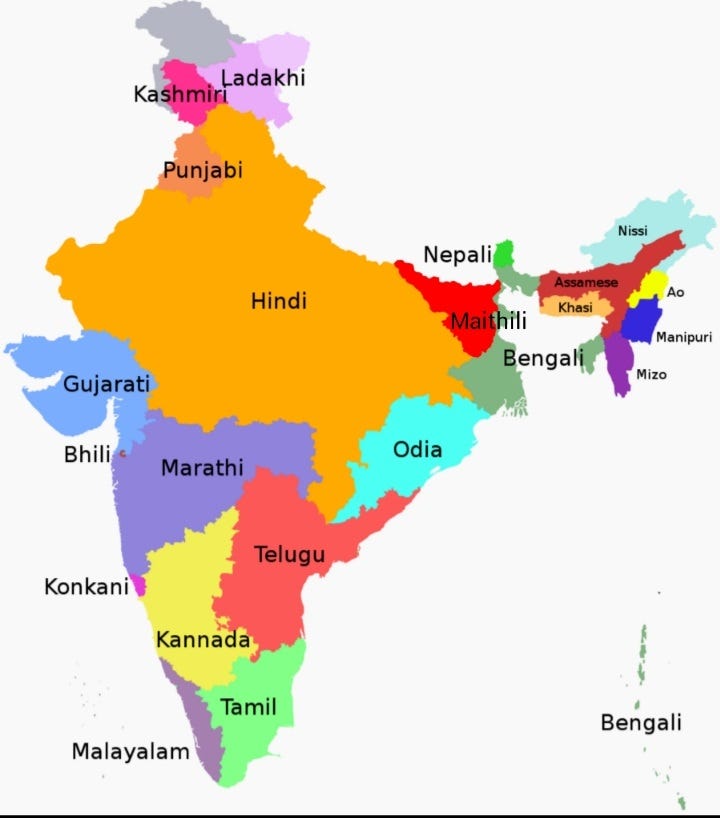
One of India’s internal squabbles, little known to outsiders, is its rancor over languages. There are numerous languages spoken in India, with each state having its own—in Tamil Nadu, Tamil, in Maharashtra, Marathi, in Gujarat, Gujarati, and so on. The twist is that the northern half of India (roughly) speaks languages that fall into the Indo-European language family; the southern half, languages that come under the Dravidian language family. A Gujarati speaker can understand Hindi vaguely and learn it easily, much as an Italian can pick up Spanish. But Kannada or Malayali or Telugu, Dravidian languages all, are a closed book, a much higher mountain to scale.
2.
The national language, Hindi, is a Northern Indian, Indo-European language. It boasts over 600 million speakers, far more than any of the smaller regional languages in the country. It used to be the same language as Urdu before the 1947 division of the British Raj into India and Pakistan, and many Hindi speakers, if they have a familiarity with Persian and Arabic loan words (my own last name is a Perso-Arabic loan word, actually), can understand Pakistani newscasts and political speeches readily. The poetry still mystifies me, alas, because there is way too much fancy Farsi in Ghalib. Add Urdu’s quarter billion to the tally, and “Rekhta [Mixed]”—an earlier name of the ur-language—is a formidable power.
Naturally this asymmetry causes no small anxiety among lovers of regional languages. Though sometimes called (the dismissiveness is implicit here) “dialects,” they are huge languages in their own right, with literatures and long histories. Tamil is one of the oldest living languages in the world, has about ten times as many speakers as Greek, and holds a central literary and civilizational role: the “Bhakti movement,” a revolutionary devotional surge in Hinduism that accounts for many modern Hindu practices and religious attitudes, originated in Tamil Nadu and Tamil poetry.
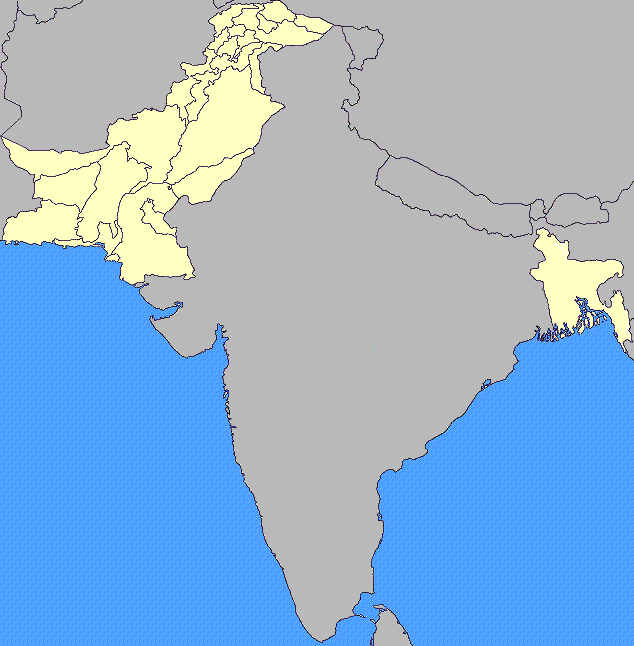
Indians take their languages seriously. The two states of Gujarat (my own ancestral region) and Maharashtra used to be a single state, at the time India gained its independence. Riots followed, and the states forced a division along linguistic lines. The original Pakistan consisted of an Urdu-speaking West Pakistan and a Bengali-speaking East Pakistan. In 1971, a bloody civil war caused that country to divide into modern-day Pakistan and the country now known as “Bangladesh”—literally, “land of Bangla,” where “Bangla” can be construed either geographically—as Bengal, the place—or linguistically—as Bengali, the language.
3.
Yet Tamil and Hindi both have something in common: A deep vocabulary borrowed from an ancient language, whose grammar neither of them share. That language is Sanskrit, the language of the Isha Upanishad. One in ten classical Tamil words are Sanskrit-origin, with a higher percentage for religious writings and a lower percentage for everyday Tamil. This is actually on the lower end for Dravidian languages. Telugu, spoken in Andhra Pradhesh, has a thirty percent Sanskrit vocabulary; for Kannada, spoken in Karnataka, almost half the words come from Sanskrit, roughly the same percentage shown by Hindi. But Hindi is written in Sanskrit’s script, while the others are not.
Sanskrit’s script, as an aside, possesses a lovely name: Devanagri, “City of the Gods.”

4.
Sanskrit poetry is metrical and generally unrhymed. Sanskrit has numerous meters; the Gita, for example, switches between two. A few meters are workhorses, accounting for the bulk of poetic output, most famously the sloka meter. Rather than go into a pedantic discussion of quantitative versus qualitative meter, I’ll roughly describe how it sounds: Imagine a couplet with sixteen beats to a line, and a caesura or pause in the middle of each line. So if you’re just listening to it, it almost sounds like a quatrain. In this it has a vague kinship with the French Alexandrine and the English ballad form.
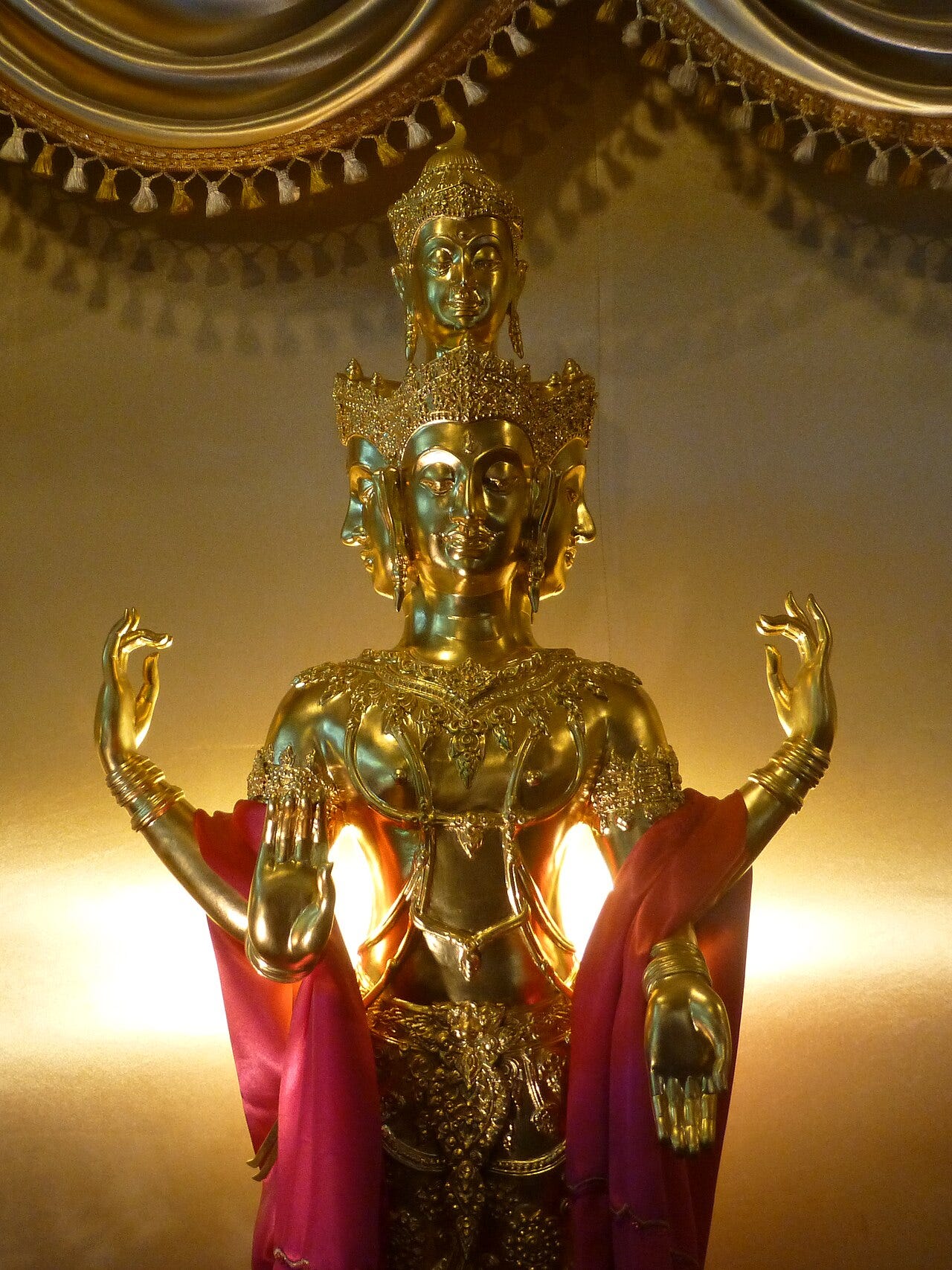
Each eight-syllable segment is called a pada, or “foot.” So the sloka has four feet, like the Vedic sacrificial horse, or the sacred cow. Four, too, is the number of the Creator Brahma’s faces, one for each cardinal direction; four, the stages of the fully lived life, student, householder, “forest-dwelling” retiree, and renunciant; four the eras of historical time, of which ours, the Kali yuga, is the corrupt and corrupting last.
5.
Northrop Frye once wrote, in The Anatomy of Criticism I think (I am working from memory here), that the iambic pentameter (five-stress) line was unnatural to English, though Chaucer, Shakespeare, and Milton had made it the standard; and that the language’s innately musical line was the four-stress line, or tetrameter, and he cited ballads and nursery rhymes as proof. And those four stresses do recur across time, from Beowulf to Sir Walter Scott’s The Lay of the Last Minstrel to song lyrics.
In English, the pentameter originated in an early Aeneid translation by Henry Howard, Earl of Surrey. That is, its use was narrative verse, just as with Milton a century later. Shakespeare used it extensively, in his sonnets and narrative poems, true, but his most famous and iconic lines and the bulk of his output was dramatic verse. Both narrative writing and dramatic writing, over the ensuing centuries, switched to prose. There is a lesson in that, one that supports Frye’s idea.
6.
Sanskrit enjoys, like Latin, what I imagine to be the compositionally liberating feature of having no fixed word order. This flexibility translates, for a poet, into reshufflability for metrical purposes. In English, there are all sorts of constructions which sound unnatural and awkward, ungrammatical, and hence irritate and halt the reader. Never more so than now, when trivial inversions for the purposes of making the meter fit or the rhyme land right are considered violations. Ancient Sanskrit poems, even sacred ones like the Gita, are full of metrical filler words like eva, dispensable bits of sound that don’t carry distinct meaning. Some commentators claim such a word is there “for emphasis,” but they really fill a hole in the metrical line. When I translated the Gita, I noticed the casual use of epithets that didn’t always carry much import—that is, there was no need to refer to how great Krishna’s hair was, or to call Arjuna the son of his mother Pritha, at that particular moment. The epithet just had the right combination of syllables. Poetry had its own shameless exigencies back then, its way of making musical demands and getting them met and so what if it doesn’t match the prose locution, that it has lost since. It was a kind of swagger.
7.
At a literary festival once, I used English to ask an Indian writer, who wrote in English, what the biggest threat to Indian cultures and languages was, and this writer declared, with almost indignant certainty, “Sanskrit!”
This made zero sense at first because Sanskrit has about 15,000 speakers. A little further investigation revealed that, in this worldview, the feared Sanskritization was ongoing through Hindi, that is, India’s massive Hindi-speaking population was a vector for Sanskrit, even though Hindi and Sanskrit don’t share the same grammatical rules.
The linguistic dread was proxy for a cultural dread, understandably: Tamil Nadu, for example, has been running a total fertility rate of 1.6 for years, and South Indian, Dravidian-language-speakers have been contracting faster than North Indians. That contracting population creates a need for workers; those workers migrate from the North.
8.
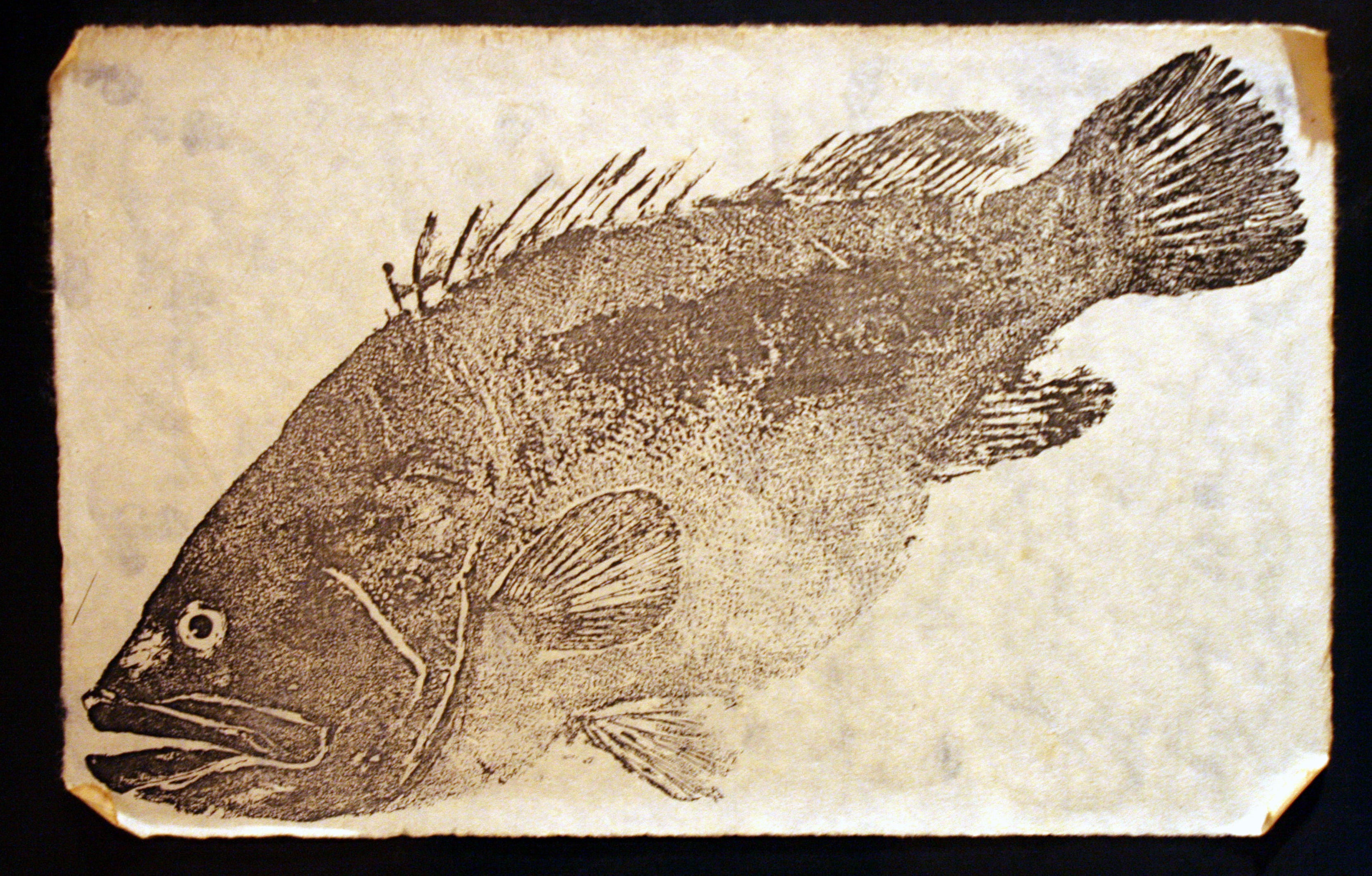
“There is always a bigger fish,” as the saying goes. (Incidentally, this idea, the Law of the Fishes, originated in Sanskrit as Matsya-Nyaya, back in Kautilya’s 2nd century BC Arthashastra.) If you think Hindi has a lot of speakers, consider English, which has three times as many. And enjoys the status of the international language of business and the sciences, and piggybacked on the British Empire and now the American one with powerful cultural exports, whether hip-hop and rap, or Netflix, or Star Wars and the Marvel Universe, or Evangelical Christianity, or the ongoing bloodsport of our fatally interesting politics. Educated Hindi speakers don’t speak Hindi anymore, they speak “Hinglish” of their own admission. I’ve never met one who could finish a sentence without grasping after English words. Sometimes I listen to formal Hindi newscasts just to tot up the English language words they have to use to make themselves understood. The British left; English stayed.
9.
And yet there are subtle ways English bears ancient, Proto-Indo-European traces that connect with Sanskrit. There are genetic residues that came in through Sanskrit’s cousin-languages from antiquity, Greek and Latin. Pitr in Sanskrit, Pater in Latin. Jnana in Sanskrit, gnosis in Greek. Trini is three in Sanskrit, which you hear in the English word “Trinity”; sapta is seven, which you hear in “September”; dasha is ten, which you hear in decimate and decimal. Nava, November, dve, duo, I could go on quite a ways further down this pantha, path, but I won’t, deferring until next week our plunge into the lingustic waters—alias apas in Sanskrit, and aqua in Latin....
Thanks for this. Curious to see where you’ll be going in the next one. I’m fascinated by the Ashtadhyayi. To have a work codifying an ancient language in a complete and instructional way rather than it being pieced together from various literary works is really a unique thing historically. But it’s more than that, almost like a generative base code for creating human voice resonance that maps the entirety of metaphysical reality. Funny that Sanskrit was his big threat to culture when it’s so elegant and foundational that way. But I do get the perspective of north south tension
Very clear overview; you have an engaging way of writing. I’ve made 4 or 5 forays into India’s history, cultures, religions and literatures, and been rebuffed each time. Probably some mix of the complexity, lack of reference points, and overly academic writing styles. At any rate there seems to be a place for an introductory book written in a lively style. Not sure if that’s your thing or not, but I suspect I’m not alone in wishing for something like that. Maybe based on Substack posts?